
This Must Be the Place
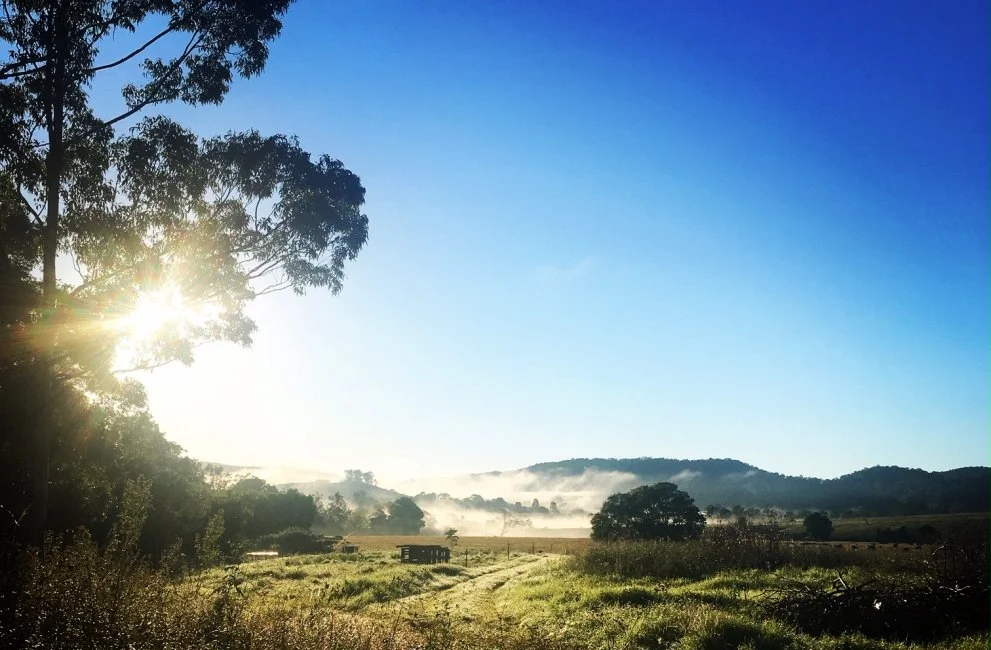
Morning view to the east at Near River
Despite initial impressions to the contrary, this wasn’t a totally reckless decision to up and leave the big smoke and head for the hills, run away from responsibility, society, and Sydney traffic. So how did we know that this must be the place? And what other matters did we consider? And importantly, what did we discover that we missed considering?
From the get go, we were clear about our commitment to growing food. We weren’t clear exactly how this would look, however our farm partners had an interest in Dexter cattle, and Therese and I would initially be growing vegetables, and we would do this organically. And whilst we were naïve in many matters, we knew we’d need assistance from the wider community to get going.
Our farm partners at the time had been speaking with the Demeter people at BioDynamics Australia in Victoria about our plans, which led to Alex Podolinsky suggesting that we connect with David Marks and Heidi Faulding from Marrook Dairy Farm at Elands on the Mid North Coast. David and Heidi had left Sydney mid-life to set up their farm that was in the area we were looking, so they could be suitable mentors for us. We set up a time to visit so we could spend a weekend with David and Heidi at the farm.
They were very welcoming and full of advice, with David most notably devoting the better part of the weekend doing his utmost to deter us from our course of action! A few of his words of wisdom that stuck were that you’ll need the same amount of money in addition to what you spend on purchasing the property to develop it, and the oft heard ‘how do you make a small fortune out of farming? Start with a big one!’ As a former accountant, to say David’s sense of humour was dusty was an understatement. We parted filled with more matters to consider, but still clear that this was what we’d be doing in the near future.
Over the weekend, David had made mention of another biodynamic farmer in the area who had his business for sale and that we might consider speaking to him. Unfortunately David has since died leaving a large gap in the organic and biodynamic community.
Tony and Josie Franckin’s farm raised free range organic eggs in a unique manner. Originally a dairy farm until the ravages of deregulation took their toll, Tony downsized his herd and moved to eggs, marrying the two by using the milk from the cows as a protein supplement to mix with the daily grain ration that the hens required. This process added to the pasture raised free ranging model that he used produced some of the best eggs ever. Therese and I spent a day with the Franckins, and considered the viability of their business for what we were looking for. Unfortunately it didn’t meet our requirements – the homestead needed modifications to house two adult couples; it was in a beautiful location but too far from town for a daily commute; and none of us had any experience with milking and animal husbandry. We had gained further knowledge, and as it turned out, commenced a valuable relationship that continues to this day, as for many years we’d transport Tony’s biodynamic veal to Sydney, and his family became regular Christmas ham customers.
Each of these farm visits and enquiries were helping us build our vision for what our farm would look like, even if that meant knowing what we would be doing. What else did we take into account?
One of the main reasons we were focusing on the Mid North Coast and Port Macquarie was the population in the region (approx. 70,000) and the associated infrastructure and inertia that brings with it. We believed it would provide a ready market for what we’d be producing, and additionally, would supply services that we’d need. We all had long standing commitments in Sydney that would require what we then thought would be irregular trips and the airport was of a suitable size - all we needed was to convince Virgin to start servicing the area to give Qantas some competition, and prices would become reasonable. Whilst the did occur shortly after we relocated, Virgin has ceased servicing Port.
One service that absolutely needed to be in place was a reliable internet connection. Our plan included Therese working her Sydney job from the end of an internet connection, so assurances and testing was undertaken. Let’s just say that our relationship with Telstra became quite close if not personal. Farming can be filled with frustrations, however none would compare to the vagaries of internet connectivity that we’d experience. Finally a few years ago Starlink became available, and despite it’s owners shortcomings, connectivity is now finally seamless. Suffice to say that the service that we now have is lightyears away from what was here eighteen years ago.
Another piece of infrastructure that has proved vital to our enterprise that we didn’t consider but fate has dealt us well with are our proximity to an abattoir. Having an abattoir close by (45kms to our north) meant that our animals could be transported on the morning that they were to be processed minimizing the amount of time they spend in transport and being held in yards at the facility. In time, we came to realise that this was also the biggest threat to our business, though that’s a story for another time.
Two attributes that were glaringly obvious were the soil on the property and access to water. The estate agent was to play a role in both. When we came to do the last inspection prior to making our offer, I told the agent that I wanted to bring a spade along so I could check the soil. He said “No problem, but in the twenty years I’ve been doing this, you’re the first person to do that”. Once at the property, I proceeded to wander through the paddocks randomly digging into the soil. At each location every spade full of soil would contain a generous quantity of worms – perfect, so much life already in the soil, the real benefit of minimal or no chemical use for over fifteen years. This was a real bonus. The water situation was not quite as rosy.
Bordering a river meant the property had a ‘stock and domestic’ license which allowed us to draw as much water as we liked to water animals and for our home use, but we could not use it to irrigate a commercial crop. However the agent assured us that as this was former dairy country, there’d be a license that a neighbouring property would gladly sell to us at a reasonable price, as they’d have little further use for it. And of course, we believed him! Read more about that in our next story Nothing’s as Precious as a Hole in the Ground.
Aside from these details, the actual property was quite a find. Whilst possibly a little further from town than preferred, the home was a solid double brick structure that could comfortably house two middle aged couples, and there was additional unlisted infrastructure that a horticulturalist dreamt of - a polyhouse in place and the frame for a second one standing ready. The property sat just below a small rise with a beautiful easterly aspect and protection from the west and south, all beneficial attributes.
What sealed the deal on the 22 acres at 1466 Pappinbarra Road? How did I know that this must be the place? Despite all research about what we needed, what really sealed matters were two trees growing in the front yard.
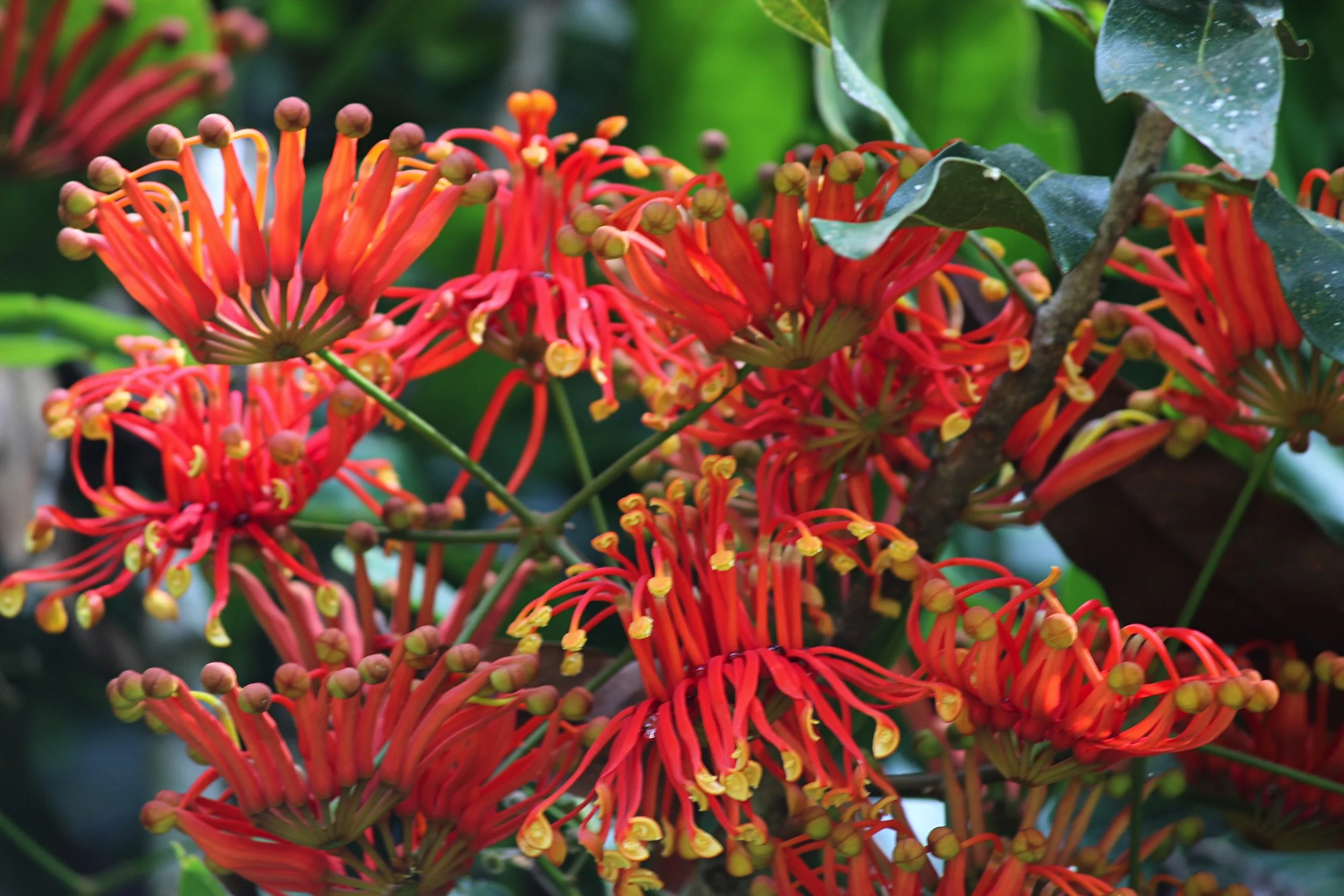
Queensland Firewheel Tree (Stenocarpus sinuatus) inflorescence
When I’d been studying horticulture at Ryde TAFE college, I discovered the beauty of a wide range of plants, and took great interest Australian rainforest trees. Seeing these beauties up close was truly eye-opening, particularly the number that had quite distinct and bright flowers. One that became a real favourite was Stenocarpus sinuatus, the Queensland Firewheel tree - just look at that flower. At the time I declared that the house that I’d live in would have one of these in the garden, and now standing on the front verandah there there it was - two of these wonderful specimens in the front garden of a property that could become our home.
Clearly this must be the place!
With thanks to Talking Heads