
Nothing’s as Precious as a Hole in the Ground
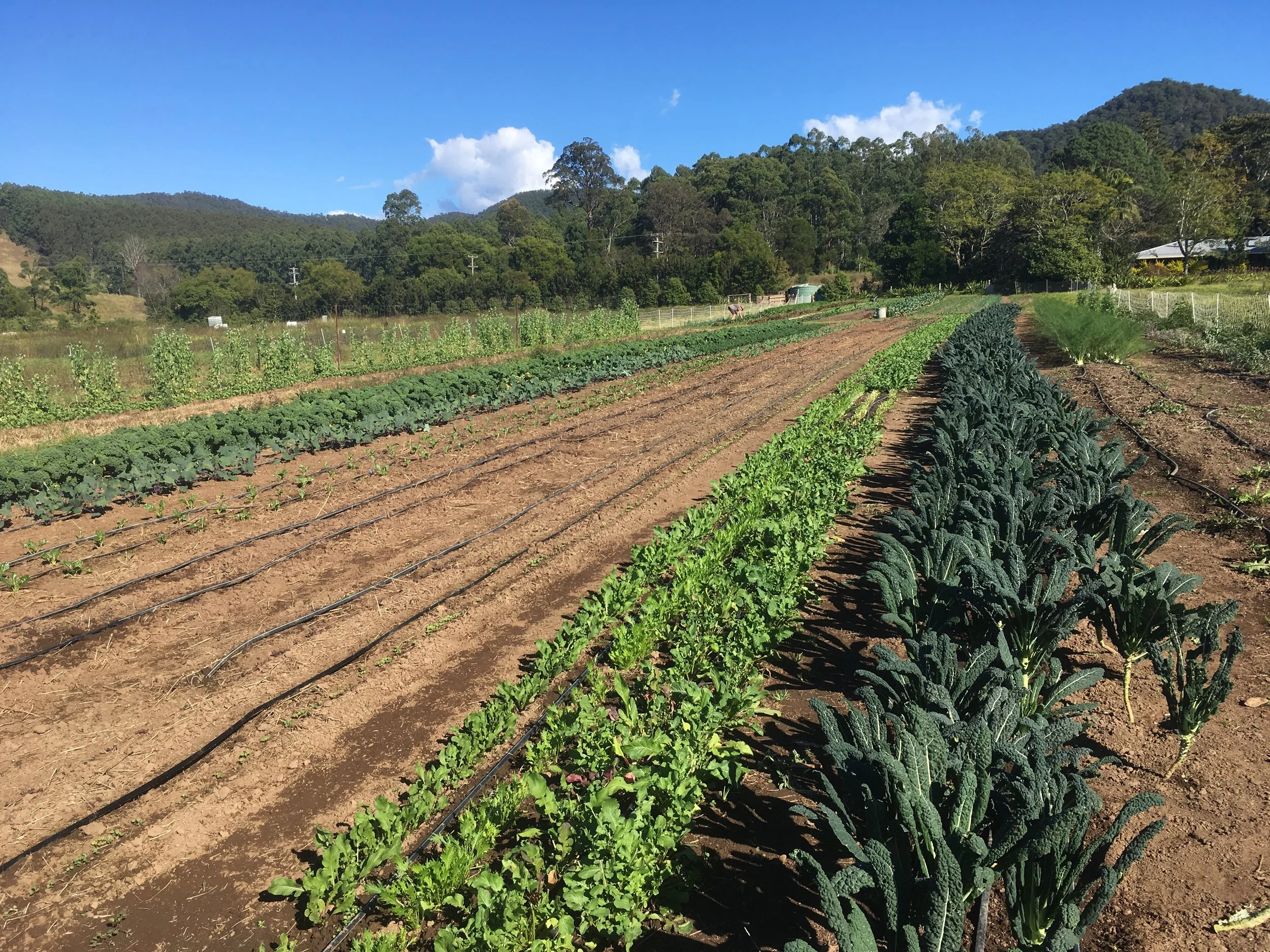
Vegetable production plot in full swing
‘Water is life’. I can’t think of truer words that have ever been said.
The checklist of requirements when buying a home is long – location, size, aspect, proximity to schools and transport, and then the actual building. Bedrooms, bathrooms, and on it goes. Our limited experience of acquiring a farm to be used for farming added many more requirements to the list. Some were familiar; others were unique to farming. Fencing, stockyard and loading ramp, shedding, poly and shade houses, dams, 3 phase power.
Near the top of the list, probably just after housing and the actual land, was water. We were 15kms from the nearest town, or village, in Beechwood, so obviously town water wasn’t a thing. No simply turning on the tap and out it came for as long as you like. The property did back on to the Pappinbarra River, which formed the northern boundary, and like all properties that border a watercourse, came with Stock and Domestic rights. This allows unmetered water to be drawn to be used to provide water for non-intensive stock on the adjoining property and domestic use.
When we enquired with the listing agent about water for crops and horticulture, he replied “all these neighbours have unused licences, they’ll be sure to sell you one.” Of course, the local agent would know the lay of the land, right? After all, we were in former dairy farm heartland, so obviously there would be many unused licences on neighbouring properties that farmers would be falling over themselves to sell to us. Remember that.
The Pappinbarra is a forty-kilometre tributary of the Hastings River, rising in the forests bordering the Werrikimbe National Park. Its clear water is one of the reasons the valley became productive dairy country. Generations of farming families built their livelihoods here, supported by the Hastings Valley Co-op and a reliable climate.
To draw water from the river for intensive agriculture, you needed both an overland water licence and a water access licence. Our quest began with conversations with our neighbours. Andre, the adjoining neighbour, was on a 160-acre farm, home at the time to the most recently closed dairy in the valley, and he had several water licence entitlements. Andre was not prepared to part with any of them, ‘too valuable’, ‘I might need them one day’ was his refrain, lines we would come to hear numerous times. He did offer for us to pump water from his licences onto our land, and whilst this provided a solution to our situation, it wasn’t a long-term proposition, nor totally legal. Water can only be used on the property that the licence applies to.
Other neighbours were approached, with similar responses. We couldn’t fathom what was going on; farms with 170 megalitre licences that had not been used in over a decade were unwilling to sell any part, even just 10% of their licence at market value.
We owned river frontage, could hear water flowing day and night, yet legally couldn't use it to grow crops. And without water we couldn’t farm what we had envisaged. The small dam at the front of the property was not of any real size, and at 22 acres, creating another one wasn’t a viable option. And new water licences for river extraction were no longer available, only transfers of existing licences.
Then it was suggested we investigate sinking a bore.
Investigate we did. There was a hefty element of risk, as with all things below the surface, there were no guarantees, and I’d had plenty of experiences in landscape construction with below the surface surprises. Most often, the real guarantee was that something untoward would be uncovered! After forms had been lodged, and the requisite time for public comment expired, we commenced.
The first step was to acquire the services of a water diviner. We were told that these folk would assist in locating underground flows, and if they were any good, would also provide an indication of how far we’d need to drill. I had a healthy dose of scepticism about this whole situation – a guy with a couple of coat hangers twisted together was going to walk around and find underground water flows and tell us how deep they were, and then the drilling crew would arrive and do their task with no guarantees whatsoever. To be clear, the drill crew charge by the metre, and keep drilling at the designated site until they ran out of shaft or struck water, and you were charged regardless of the result. All care though no responsibility. I recall having the distinct experience of a city slicker about to be taken for a ride, and a costly one at that. However, what other option did we have?
Whilst I can’t recall our diviner’s name, he fitted the bill exactly. He careened up the drive in a suitably aged Holden station wagon and rolled out of the car looking as though he may have had a schooner or two at the pub on the way through. No problem, it was a sunny Sunday afternoon after all, and we exchanged some pleasantries, he grabbed his wire and went straight to work. He surveyed the general landscape and lay of the land, much as I used to do after arriving at a new site, and after getting his bearings, used his diviner whilst walking around a general area that he felt was a possible site. I must say that when the wire ‘rod’ moved, it was quite pronounced and definitive – you couldn’t argue with its response. After a few passes to confirm the initial response with similar reactions, the position was recorded, and he then pronounced that we’d need to drill to 38 metres, no more, as 40 would be too deep, and whilst water would be found higher up it wouldn’t be at a good flow.
About a week later the drilling crew arrived with the drill rig and associated materials. Most of the day was spent boring, and to my surprise and delight, old mate diviner was spot on. Not only was the location accurate, but good flow was found at 38 metres, after passing a less reliable flow at 26 metres. Thirty-eight metres below the surface sat the most valuable asset on the farm. Not the house. Not the sheds. Not the river frontage. A hole in the ground.
Our now most precious asset was ‘lined and tapped’ with pipework and concrete, and we moved onto the next step in the process.
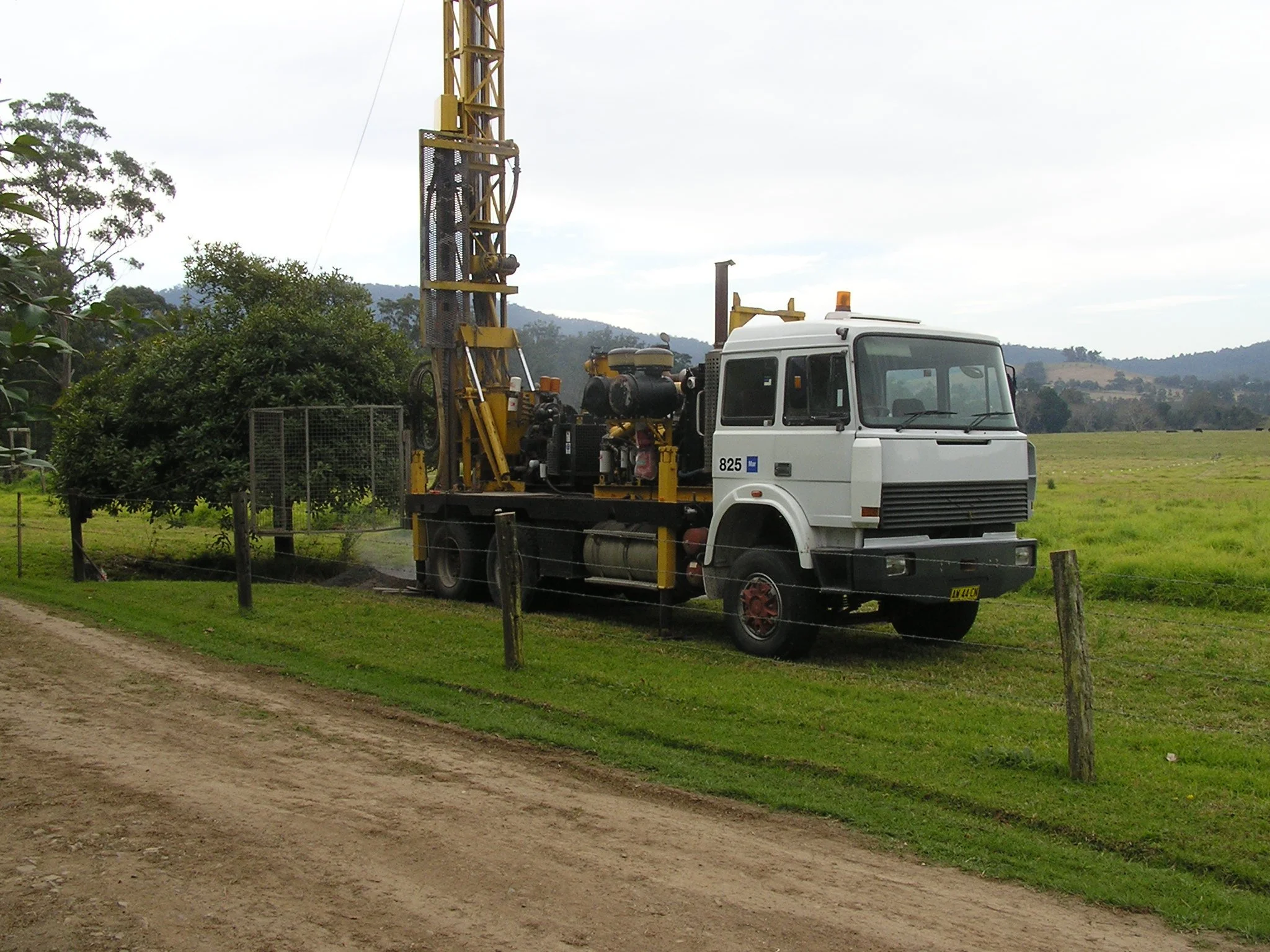
Suitably robust piece of machinery
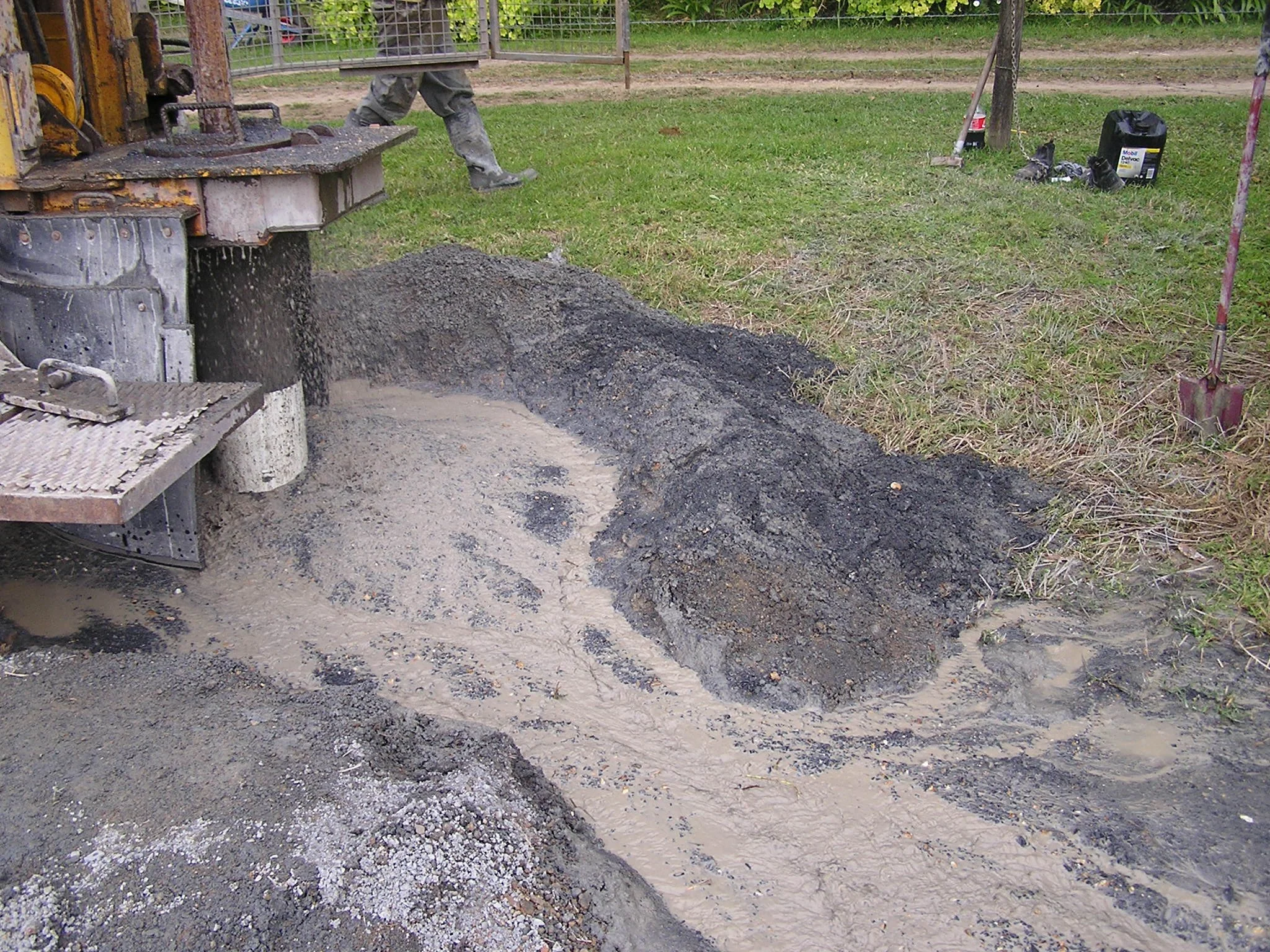
Liquid gold - the water flows
After the electrician sorted power to the bore site, a 22,000-litre header tank was purchased and positioned, and the local irrigation and pump supplier was engaged.
During my landscape tuitions I’d spent a night a week at Meadowbank TAFE for a year studying the finer details of irrigation, flowrates, friction loss, and other such matters, though they were all based on connection to suburban water mains along with the regulations that came with it. Whilst much of the knowledge was very useful the world of pumps, header tanks, pressure switches and the like was new to me. I was quite skilled at irrigating your suburban garden and lawn, however moving water around a 22-acre farm was another matter.
At the time, the Co-op in Wauchope was the place to rely on for the knowledge and skills required for the task. And whilst that entity is now a shell of its former self, thankfully the people involved were able to establish themselves independently – the knowledge has not been lost.
The system required two pumps: one to lift water from the bore into a 22,000-litre header tank, and another to distribute it around the farm through a network of submains.
Within the month the lads from the Co-op spent a day and a half on site with their trusty trenching Ditch Witch, teflon tape and pipe wrenches, and just like that, we had the bones of an irrigation system. Now my work began, tapping the submains to install valves and pipework for the production beds.
At the end of the week, after a few extra trips to town for more irrigation bits and pieces, the pumps were fired up, the valves opened, and the liquid flowed right to where it was needed.
Years later, when I think about everything we considered important when buying that farm - houses, sheds, fencing, power - the thing that ultimately mattered most was a hole thirty-eight metres deep. Without it, none of the rest would have mattered.
Water for life indeed.