
Abattoir Blues
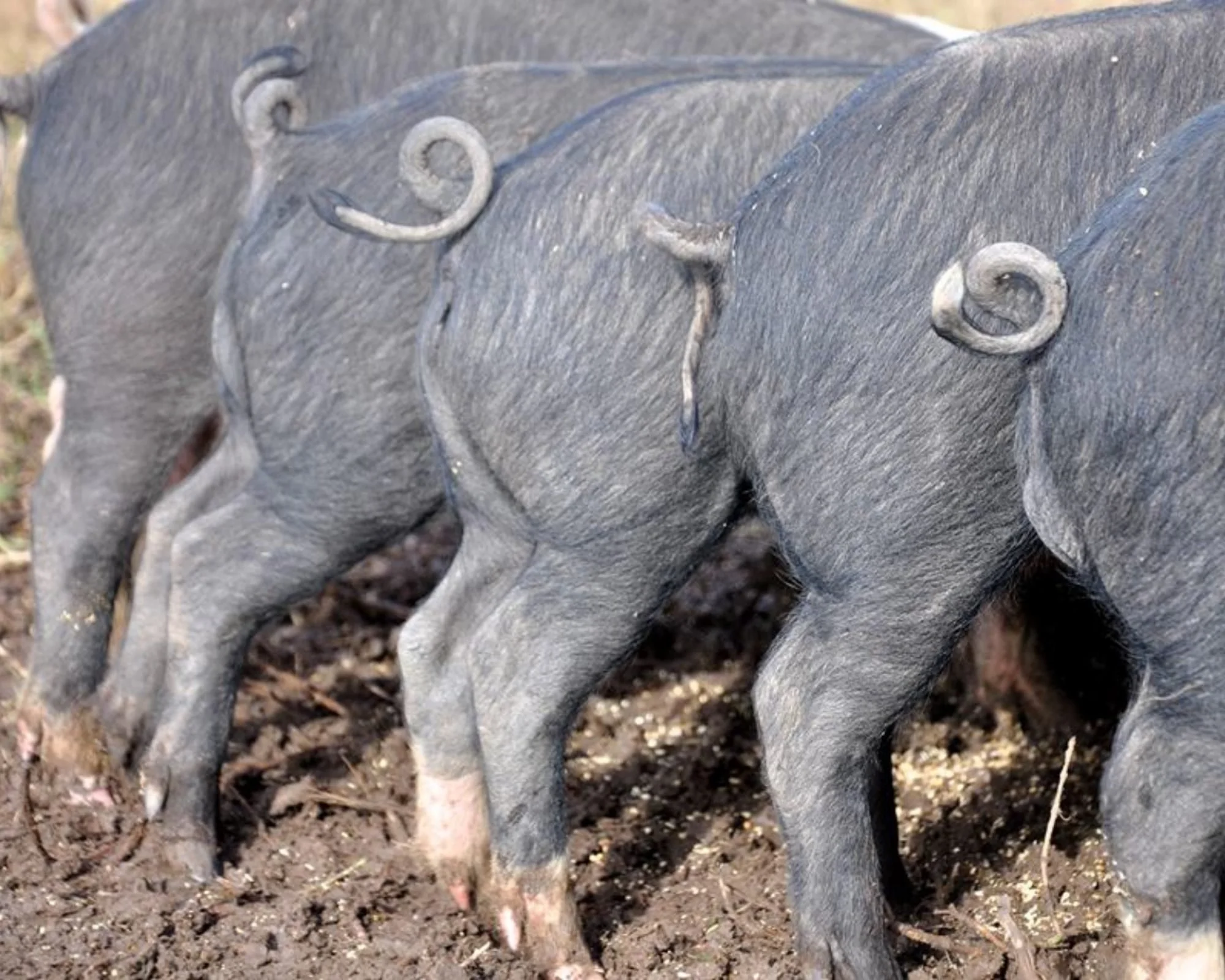
Near River Christmas hams in the making Image by Sarah Churchward Norton
Whilst most of these stories have been in vague chronological order, this one jumps ahead several years. I’ve been spurred into writing this now due to a new artisanal producer having their carcasses misplaced, a rather unprofessional incident that reminded me of our introduction to the often slapdash, 'who gives a…' attitude that small artisanal producers frequently encounter when they enter the mainstream processing chain.
Amy and Tom at La Connor Ridge are new first-generation farmers down in the Hunter Valley near Tocal at Paterson. They are swinging out and giving this farming game a red-hot go, currently with 4 sows and some cattle, which they are direct marketing online. Do check them out at www.laconnorridge.com.au We’ve effectively passed a baton onto them, helped them with some freight and knowledge, and sold them some loading gear. When Amy posted about their dilemma recently, after an audible expletive followed by a very brief chuckle, I was reminded of our baptism way back when we began.
And a disclaimer – there’ll be discussion about the process which may present some ideas that occur as confronting to some, as unless you’re a farmer, or otherwise grow and/or butcher your own meat, we’ll mention things that you’ve probably never thought about.
Ideally, pigs are the one animal that the farmer knows they are truly receiving their animals after processing, as it’s the only species that isn’t skinned in the processing process. So long as the body has been slap branded or ‘tattooed’ effectively whilst still alive, which is a requirement of all pigs prior to leaving a farm, each body should go where it’s meant to go. For the record, all other forms of four-legged animals we consume are also tagged, though their plastic ear tags are removed during processing, and commercial pork facilities will process between 1,000 – 2,000 bodies a day. With the LaConnor Ridge batch of pigs, 13 of their animals were processed in addition with animals from other producers at a small scale (micro) abattoir, which I’ll describe further on. The freight company arrived the next day and collected 13 bodies however failed to check the tattoos adequately, and 3 ‘other’ bodies were mistaken as LaConnor Ridge and delivered incorrectly. The problem arose early the next week when the carcasses were being broken up and the error came to light, though clearly too late to rectify the situation.
In bulk processing, I'd be surprised if this doesn't happen constantly. And you can say, so what, pork is pork, what’s the problem? Thirteen pigs in, thirteen pigs out. However, when you lavish care on an animal, nurture it from conception to personally delivering it to the processor, you become very attached to having the carcasses that are picked up being the right ones. At the very last hurdle they had been ‘mistreated’. Yes, Tom and Amy will get over it. Some of their customers will miss out, maybe even lose interest due to the inconvenience, and there will be a financial impact. However, it was Amy’s response that jogged my memory – “Last time we use that freight company. Think we’ll have to do it ourselves in future.”
So much of the Industrial Food Complex is stacked against small scale artisanal producers, and whilst initially I didn’t understand these constraints, over time I began to realise what it was all leading to. Such a vast all-encompassing topic won’t be fully addressed here in one post, though I’ll cover the part that is pertinent to small scale animal production, and our lived experience.
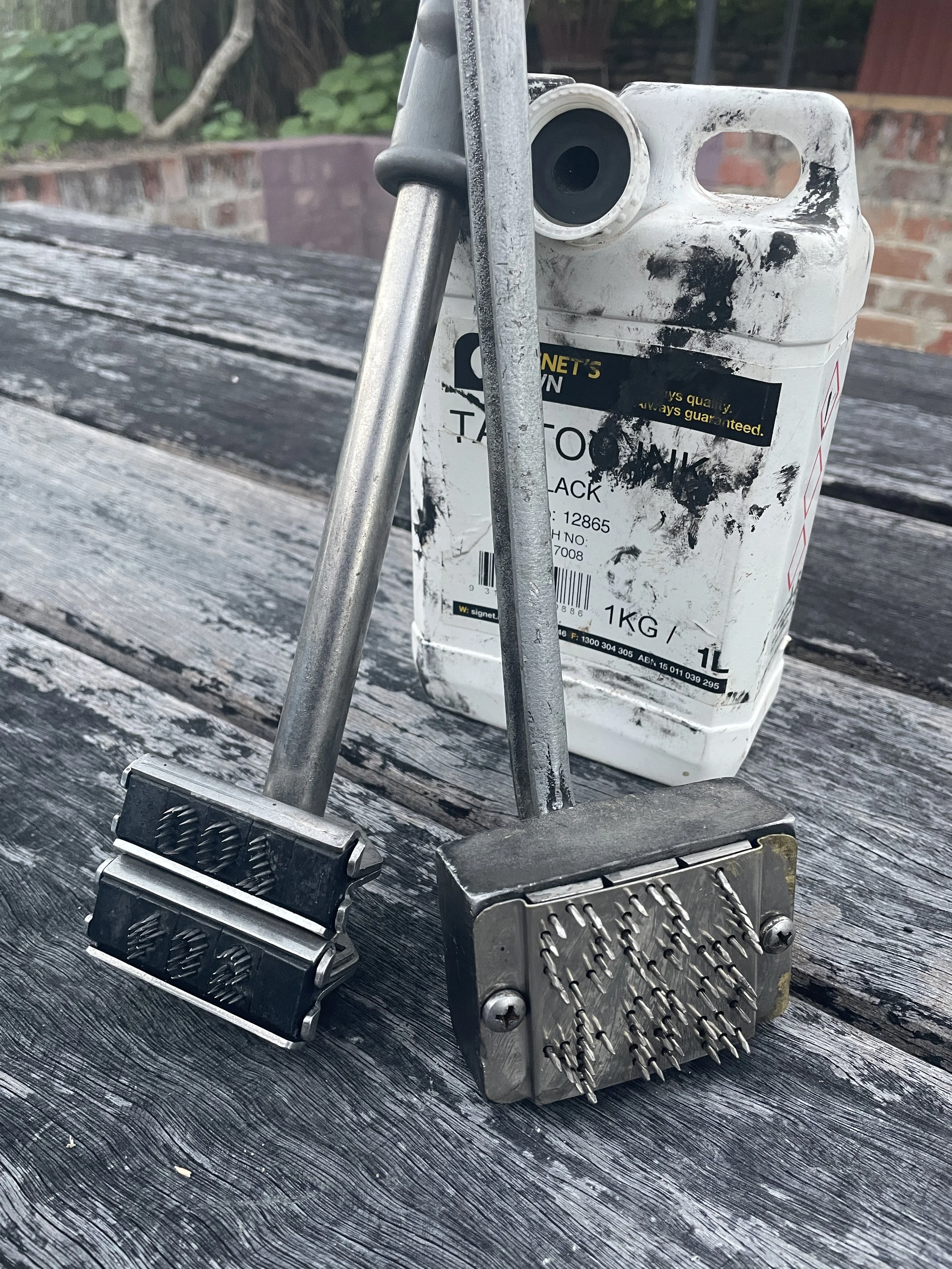
The slap brand that we used to tattoo our pigs with our unique PIC number
We lucked out without knowing it when we purchased Near River. For the first few years we concentrated all our activities on market gardening, growing vegetables for CSA boxes, and garlic as a cash crop. When we turned our hands to pig raising, having an abattoir 45 minutes up the highway was such an asset, one that we wouldn’t fully appreciate until it was gone, or gone for us.
With our lack of generational smarts, our exposure to the whole animal processing chain was eye opening – transport to the facility, the actual processing of the animal, and then the transport back to a butcher or other end user is steeped in process, regulation (understandably), and tradition. Whilst we thought nothing of our presence with two pigs to process in this system, hindsight and an appreciation for economics now makes me wonder how we even got let in the door in the first place.
Anyway, we did. Our first two pigs made it through the system and back to the local butcher who did a fine job dealing with this uneducated ‘farmer’ about the best way to portion a pig.
Like all the produce we’d grown, it tasted amazing, not like any pork we’d eaten before – it had real flavour and was sweet. It appeared this pork game was a way forward. After doing our darnedest to prove Joel Salatin wrong (one of his many maxims is “It’s easier to raise and market 50 pounds of protein than it is to raise and market 50 pounds of vegetables”), the niche of pasture raised pork was feasible and suited the size of our farm, and we could scale up with little additional infrastructure. Our existing trailer was a suitable transport option, and they didn’t require fancy loading ramps. Whilst sturdy fencing is a requirement, a good electric fence charger goes a long way to retaining them where they are meant to be.
Quite quickly we were processing pigs on a weekly basis as our farmers market activities improved. The week would start loading pigs early on Monday morning, to be dropped at the abattoir in time for the days process, and the abattoir would deliver them to our local butcher to do the cut up and package by Wednesday, enabling us to label each portion ready for the weekend market.
We learnt about the various cuts of pork that come from each part of the animal, the difference between spare ribs and baby back ribs, scotch and neck, cutlet or chop, and on it went smoothly for some time.
Initially we’d transport our pork in car fridges and eskies with freezer packs, which was fine for our market sales, though delivery of whole animals was a different matter. And then our abattoir lost one of our pig’s post processing. Failed to deliver it, with the first knowledge to us being a call from the client on a Friday afternoon, wondering when the delivery would occur. No apology, reason or excuse was offered, nor any recompense. Suck it up buttercup and move on.
“Last time we use that freight company. Think we’ll have to do it ourselves in future.”
Our brand and reputation were growing, and at some point, one evening we sat down to do a SWOT analysis, identifying the most obvious threat to our business was relying on the abattoir to process our animals. We had a firm hand in all the other aspects in the supply chain involved in processing of our artisanal animals, including an achievable plan to control the transport of all our output. However, we realised at the time that there was little we could do about the abattoir.
About eighteen months after this realisation, I received a voicemail from the abattoir informing me that the process planned for the following Monday, a mere 48 hours away, would be the last time they were able to process our pigs. What the …? We’d been dealing with these folks weekly for over 5 years growing to 6-8 pigs a week, which they honoured with 48 hours’ notice via a message. Rug firmly pulled.
It was a multi species facility and processed around 1000 pigs each week at around $30 each. One of their other income streams was Halal certified meat meal, a necessity in Halal egg production. It brought in $100K each week, and the pork processing was a constraint to that. As a commercial decision I understand why the move was made, however the execution lacked finesse.
Obviously with an abattoir that close by, we weren’t the only farmers impacted. We were in a quandary – we had a farm full of pigs, and orders and markets that relied ideally on weekly processing. Our two options for processing were both four and a half hours travel time away from Near River – one north inland from Byron Bay, the other on the outskirts of southern Sydney at Picton. And then the matter of getting our animals back for portioning and marketing. Who’d be a small-scale artisan farmer?
We did a couple of runs to Picton with pigs for our Sydney butchers, though economically that was unviable as we missed out processing pigs for the other markets we supplied. Looked like a fortnightly trip to Byron Bay was the least bad outcome, as in one run we’d process all the pigs we needed, be able to collect them the next day and return to have them portioned or delivered as whole carcasses to our customers in Port Macquarie, the Hunter Valley and Sydney. This reality meant I’d be on the road three days a fortnight. We’d had brief conversations with freight companies who provided transport out of the facility at Byron, though they weren’t interested in 20 bodies – they had a 50-carcass minimum, with no real thought about how you get from 10 carcasses a run to 50. So, we bought our own refrigerated truck.
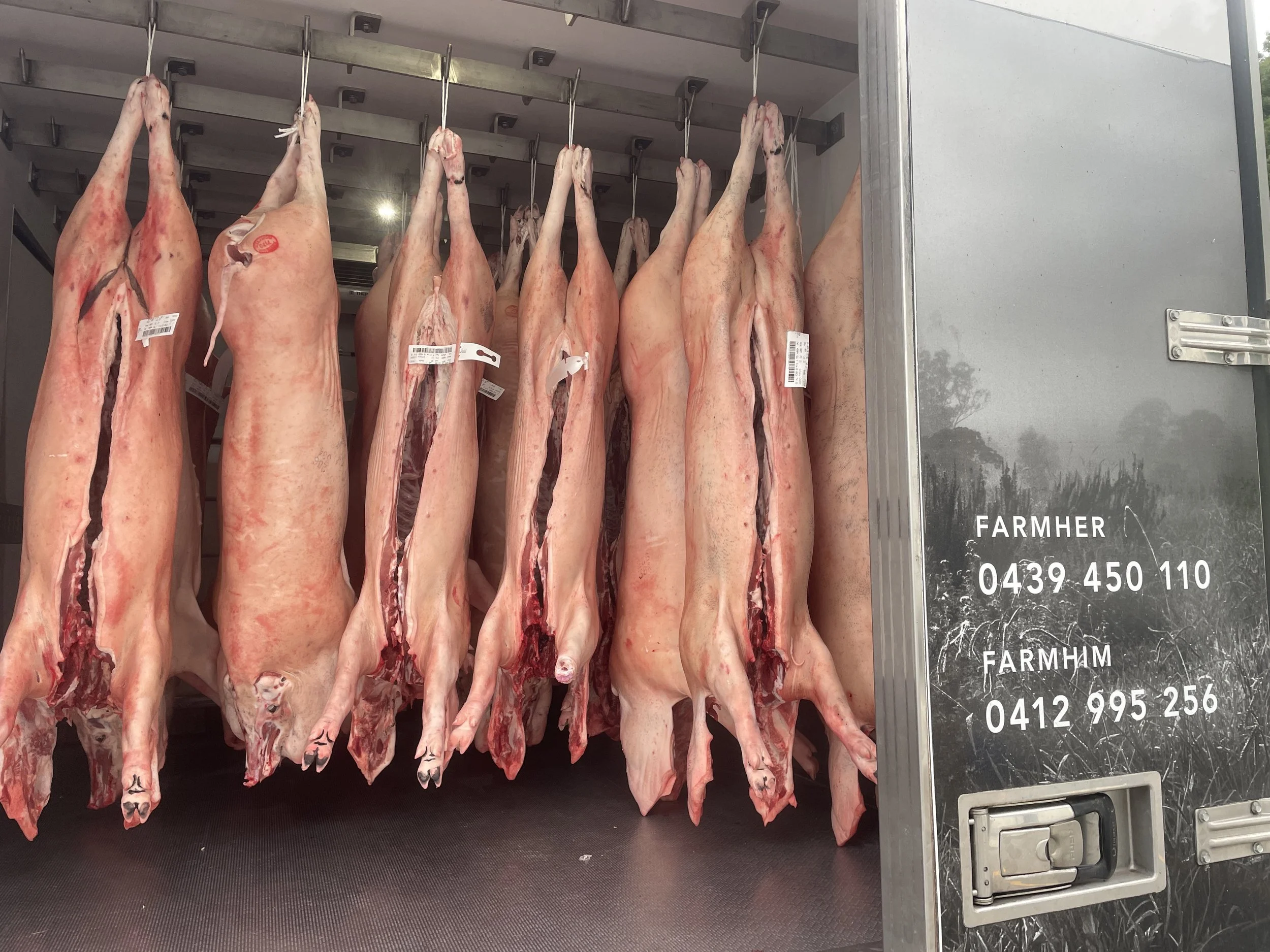
A truck load of pork
After the initial shock and realigning our clients to the new logistics, the system flowed pretty well for a few years, until …….
The facility at Byron ran two streams. Whilst it was a dedicated pig abattoir, they ran AQIP certified process in the mornings, and non-AQIP at the days end. AQIP is an industry quality assurance scheme, mandatory for export commodity pork. Our clients neither required nor valued it, and our own approach was full transparency—anyone was welcome to visit the farm and see how we raised our pigs.
In their wisdom, the Byron facility announced by email that they’d cease processing non-AQIP pigs in 90 days. I do understand their challenges – abattoirs operate on tiny margins, so need scale to work, and differing inputs have an adverse effect. In this case, the offal from the non-AQIP pigs could not be sold, so cost was involved in its disposal. For us, whilst this was a new constraint with another layer of regulation that in our situation would do nothing to improve the quality or flavour of our pork, at least we had time to meet the new requirement or make other arrangements. The industry body APL stepped in and helped, even gaining an additional extension from the facility for producers to meet the new requirements.
Despite our best efforts, we were unable to reach the AQIP standard due to a planning technicality that I’ll detail in another post. So now to find another abattoir.
Around the time our initial abattoir ceased processing pigs, we explored the idea of a micro-abattoir on our farm. Housed in a 40 foot shipping container, there was one that had been operating outside Dubbo. We made some enquiries, ran some numbers, and came to realisation that heading down that path would mean we’d be in the abattoir business rather than the farming business, and that wasn’t for us. However another farmer in the region did make the jump, got trained, bought the Dubbo micro-ab, and did the required building and certification and got it going in Comboyne, a mere hours drive away.
The upside with this facility was the savings in fuel and travel time, though the downside was the 100% increase in processing fees; I certainly understand bespoke craftsmanship, however would our customers? Regardless, we moved across to the micro abattoir (we really didn’t have a choice) and for the next year or so operated utilising their facility, until it happened again. We discovered from one of our clients that the micro-abattoir was for sale with every likelihood of it being relocated out of our region.
We’d had two abattoirs cease to service our pigs, and now a third was moving on, albeit at some stage in the next 6-18 months. We decided that the uncertainty was too great and chose to close production, winding up at Christmas 2025 after 15 fun filled years of growing pigs.
As I write this, there are only five abattoirs remaining in NSW that process pigs. A similar situation exists in other livestock streams with diminishing access to abattoirs a problem, particularly for small scale producers. The on-going consolidation and economics of this trend are likely to continue. There is a glimmer of hope - Victoria altered their planning laws at the end of 2025, thanks to the hard work of Tammi and Stuart at Jonai Farms and the Australian Food Sovereignty Alliance. From Tammi’s recent post “August 2025 was a watershed moment in the struggle for food sovereignty, as the Victorian Government announced we had won the reforms we had been fighting for since 2017.” The result: small operators can now build and run a micro-abattoir without a planning permit, provided they stay under 120 tonnes a year.
Our activities at Near River have never been solely for financial gain, rather it’s been about real food and our community, whether that’s the families we met through our market stalls, the chefs championing small scale producers or our butchers heroing pasture raised heritage pork. We’ve now handed that baton onto the next group of folks keen to step into the breach, with the energy and fight that small scale artisanal producers require. Folk like Amy and Tom, and all power to them.