
Organic certification, sustainability, and regenerative agriculture – Aren’t they just catchy marketing terms?
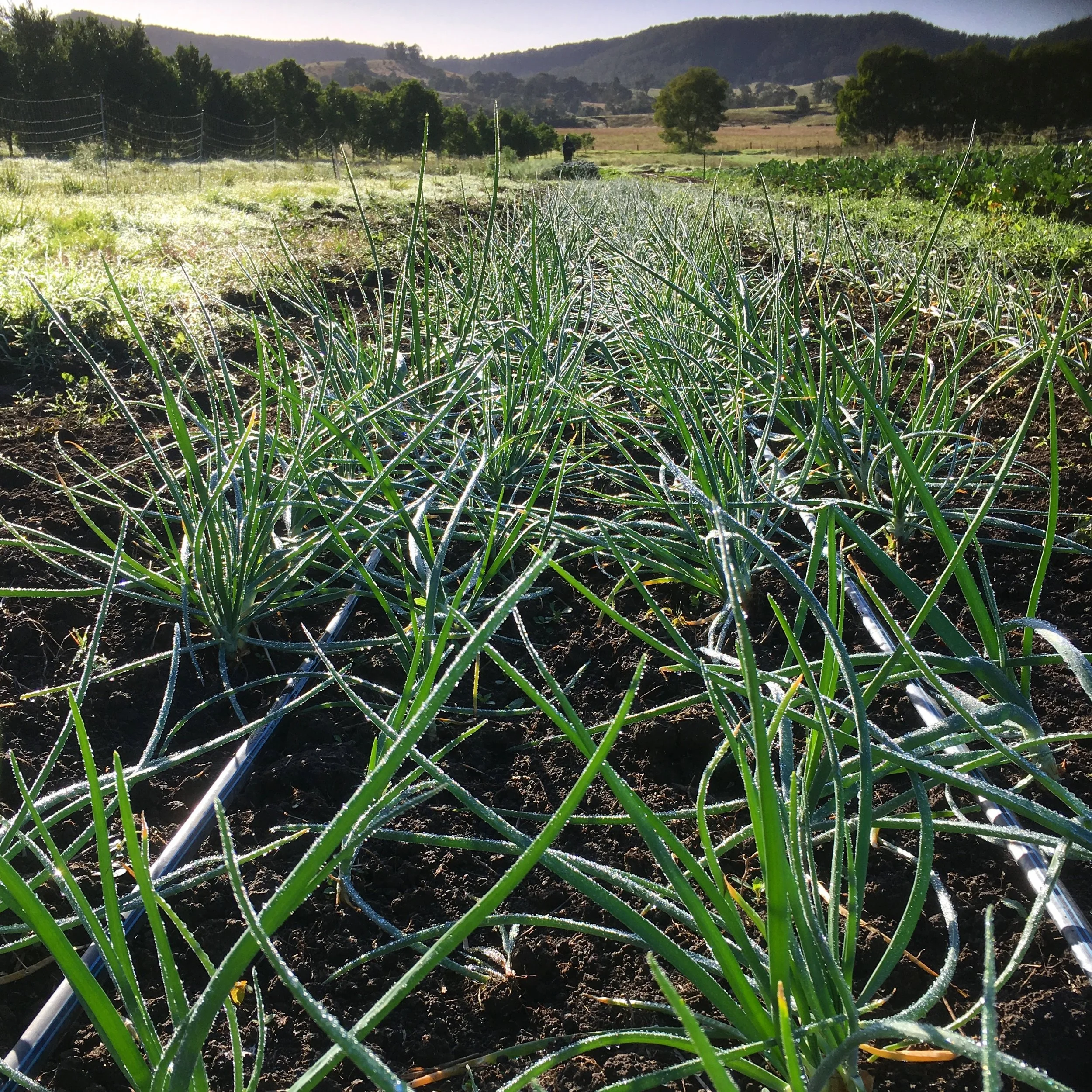
A few weeks back we achieved organic certification for our farm, or at least the 5 hectares out of the total of 9 that we actively grow produce on. This is a milestone for us for several reasons, not least that it’s been a goal we’d originally set out to achieve when we first commenced our farming journey back in 2007. Let’s see why it’s taken so long, and how far from our goal did we ever really stray from along the way.
The main impetus driving all we have ever done here at Near River is the undeniable connection between soil health, plant and animal health and hence food quality (nutrient density and flavour) and then obviously human health. Western society’s rise in chronic preventable disease can be tracked with the decline in the nutrient density of our foods and the rise in the amount ultra-processed foods make up our diets.
Twenty odd years ago when this dream of becoming farmers and growing food for our community began to take shape, our research was led by leaders in the fledgling real food movement in America. Three names would become beacons for us; Joel Salatin, farmer and author from Polyface Farm in Virginia who pioneered pasture raised chickens and direct marketing; Michael Pollan, journalist, author and professor at Harvard and concurrently at UC Berkeley who is best known for his books that explore the socio-cultural impacts of food, such as The Omnivores Dilemma; and Alice Waters, chef, restaurateur, food writer and author who is credited with starting the farm to table movement through her restaurant Chez Panisse.
At this time, as the real food movement slowly started gathering momentum, several documentaries were released that peeled back the curtain on what would become known as Big Agriculture and shone a light on their practices, the impacts on farmers and the food they created. Notably for us, Food Inc. exposed the industrial production of food in the U.S., highlighting issues regarding corporate control, health, and environmental damage; The World According to Monsanto was based on a three-year-long investigation into the corporate practices around the world of the US multinational corporation, Monsanto ; and to a lesser extent, Food Matters which took a hard-hitting look at how the food we eat was helping or hurting our health, and what we could do to live (and eat) better. These spurred us on in what occurred as a righteous crusade. Please remember that at the time we were impressionable new (or should that be green) converts who thought our zeal was no match for whatever hurdle was put in our way.
There were many reasons we chose the property that became Near River, and that’s a whole other story, however one of the benefits of the 22 acres was that it hadn’t been intensively farmed by the previous owner. Dianne and her extended family ran a number of horses, having lived here for over 25 years. Whilst there was evidence of judicious herbicide usage around the house, the paddocks had been left to their own devices, perfect for what we wanted to do, or so we thought.
As a horticulturalist, my initial plan was to grow vegetables. All our available capital had been used to purchase the property, so it was down to an extensive collection of hand tools from my landscaping business and our own backs that had us commence clearing the acre that would become the market garden by hand. Digging, turning and pulling out the rhizomes of the all-persuasive kikuyu. We’d start each morning by putting in an hour each before breakfast and chipped away at it. It was tedious and physical, though fulfilling. We have since found out that the locals were running a book on us as to how long we’d last before succumbing to the Dark Side and reaching for the glyphosate herbicide. Remember that zeal I mentioned earlier – that’s what kept us going. Whilst an application or two of Roundup would have been quick and easy, the thought of the impact that would have on the soil and all that was living in it was not worth considering. We persevered and have continued to be pesticide free to this day.
Similarly, when we researched raising pigs outdoors, time was spent identifying ways to care for the animals holistically in a preventative way rather than being reactive. For example, a dose of diatomaceous earth for the sows around the full moon aided worm prevention, and the addition of powdered oregano oil in the feed for the weaners and sows were some of the practices that ensured our animals were cared for. Their lifestyle with the sun on their backs and the ability to wallow and root and have a mixed diet also added to their health and vigour.
However, feeding pigs certified organic feed was not an option – it was not economically viable for us. Perhaps if you had a couple of hundred acres spare to raise your own feed crop, well then sure, but we only had 22. So, we did our best by ensuring the wheat we sourced was not desiccated (the practice of spraying the entire crop just prior to harvest to ensure the wheat is all uniformly dead, or ‘ripe’), and that the yield we ‘rescued’ from local artisan brewers and cheesemakers was organic.
In December 2025 we closed the pork side of the business, and in the lead up to that decision, had been looking for what was next at Near River.
In the middle of the market garden, I’d planted a row of eighteen Persian lime trees and a handful of lemons the first year we got here. After some initial TLC, they’d been left to fend for themselves, aside from a biannual prune. The fruit they produced was prodigious and of good enough quality to supply some of the restaurants that we supplied with pork. Of course, there was the answer. Specialty citrus - Persian limes, Meyer lemons and Yuzu, grown organically. In many ways we would be returning to what we’d originally set out to do, organic horticulture.
The irrigation submains were still in place in the market garden as well as the shelter belt plantings and it’d been some time since pigs had been run through that part of the farm. The paddock was slashed, rows marked out and created, irrigation lines and sprinklers installed, and trees planted, giving us a total of 175 citrus in the top acre of the old market garden.
These new plantings will take a year or two to produce fruit at any quantity, which lined up with what I thought would be the timeline for finally achieving organic certification. A broken foot provided the final impetus as it tied me to the desk for a month or two, allowing the farm plan and other relevant documentation to be created, the fees paid and all submitted. The process was painless, even easy, far from the onerous task I’d always imagined it would be. Perhaps I really did know about organic farming, and all the online research, reading, farm visits and field day attendances did amount to something.
Fairly promptly our certifiers, Southern Cross Certified, had lined up an auditor and the date was set. We passed the physical audit with flying colours, with a note in future to source certified organic tree stock for our plantings. The auditor left with a soil sample for testing, with the results to be known in a week.
The results came back. Our soils were clean with no trace of glyphosate nor other undesirable inputs, which meant we had gained certification from that point forward. We were expecting at least a year or two in transition – when conventional synthetic chemical farms commence their certification process, from the initial audit there is usually a three-year transition period, known as ‘in conversion’, until they can claim full organic certification. This was a great recognition of our skills and commitment to a way of farming that has a less adverse impact on our environment, with the food we produce being cleaner and arguably filled with more beneficial nutrients.
This achievement means several things for us. Firstly, we haven’t really wavered from our initial goal, it simply took us a little while to get here. Additionally, while sceptically the terms organic, sustainable and regenerative can be viewed as catchy marketing terms, to those that have any interest in knowing how their food is grown and what they are putting in their bodies to sustain life, they are vital descriptors, and when backed by third party certifiers provide a great level of assurance.
Greek physician Hippocrates is alleged to have said ‘Let food be thy medicine, and medicine be thy food’, with an updated version being ‘You are what you eat, so don’t be fast, cheap, easy or fake’, either are fine maxims to live by.